
Beyond the spreadsheet: what synchronized supply chain planning actually looks like
The planning meeting starts at 9 AM. By 9:15, someone has pulled up a spreadsheet. By 9:30, three people are debating a number that was accurate two days ago. By 10:00, a decision is made, and by Thursday, the situation it was responding to has already changed.
This is not a people problem. It is a system problem. And it is the default state of supply chain planning in most mid-sized companies.
The fragmentation gap
Most companies have invested in ERP systems. Many have added WMS, TMS, and SRM tools on top. But the planning process still runs on a combination of data exports, spreadsheets, and institutional knowledge held by a small number of experienced people.
The result is a consistent gap between what the systems know and what the planning team can act on, at the speed the business requires. Gaps are discovered late. Responses are reactive. The cost appears as emergency freight, missed customer commitments, and inventory sitting in the wrong place.
In the SCOR-DS framework, the Supply Chain Operations Reference Digital Standard, the Plan process is designed to be the central nervous system of the supply chain, synchronising demand, sourcing, production, fulfilment, and returns. In most companies, it is not functioning that way. The tools exist. The connection between them does not.
What a synchronized planning system actually looks like
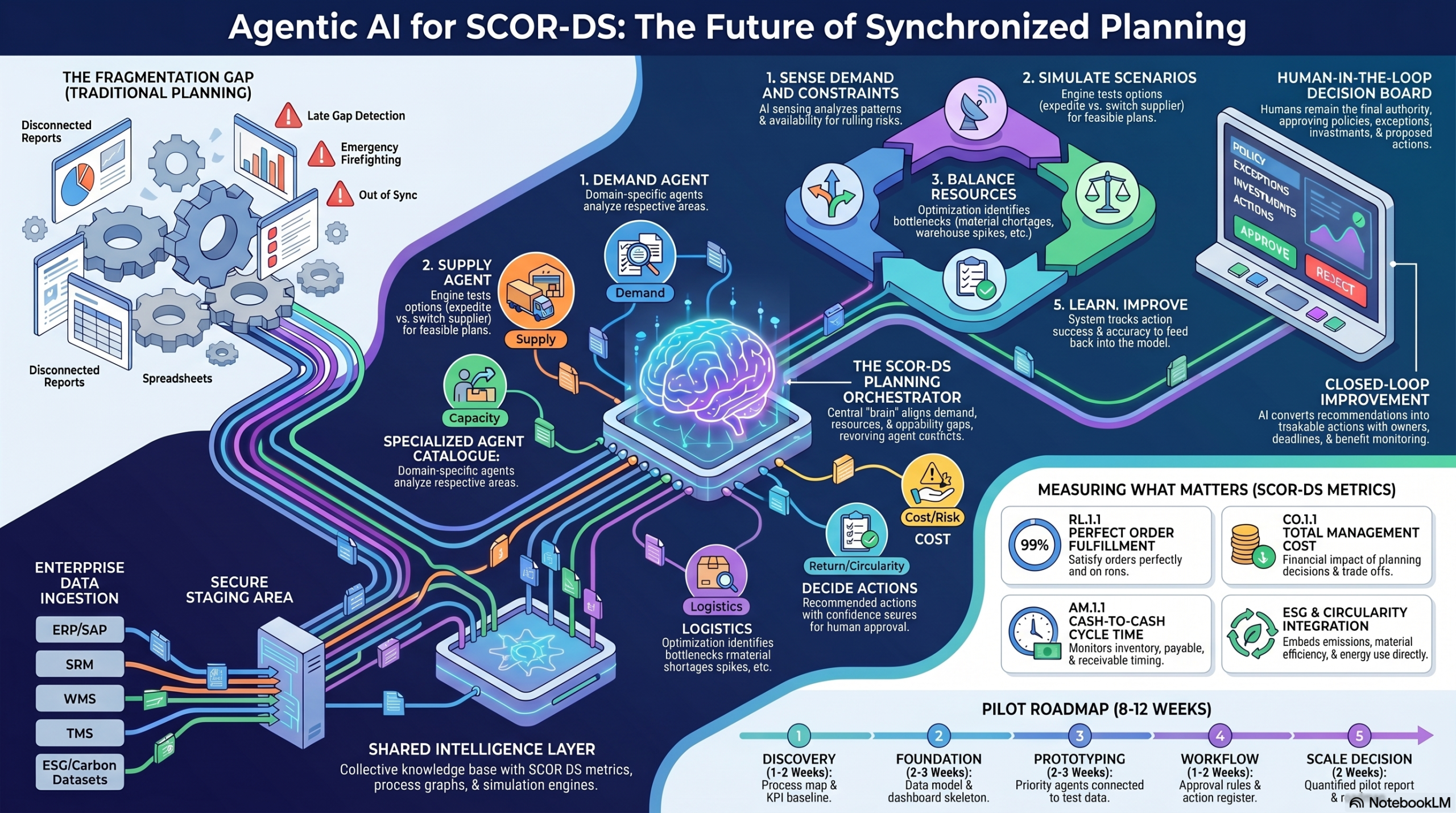
The model illustrated above replaces a single planning tool with a set of specialised agents, each responsible for one domain, coordinated by a central planning layer that holds the full picture and resolves conflicts between competing priorities. Here is what each part does in practice.
The demand agent works before the meeting
It continuously reads demand signals and identifies pattern shifts before they become shortages. It does not wait for the weekly S&OP cycle. When a shift appears, it alerts the planner with a recommendation and the supporting data, not a raw export to interpret.
The supply agent tests options before the crisis
When a supplier misses a delivery or shows reliability risk, the supply agent does not just flag the problem. It tests alternative sourcing options against current production constraints and presents the planner with a ranked shortlist. The decision remains human. The research does not.
A 21-day warning window instead of a 24-hour scramble
The capacity and logistics agents continuously cross-reference demand requirements against resource availability. In the scenario this architecture is built around, the system identified a material shortage 21 days before it would have affected the production schedule, enough time to rebalance inventory or evaluate an alternative supplier from a position of stability rather than desperation.
That is the difference between a proactive response and a panic freight order.
Sustainability enters the decision before it is made
The cost and sustainability agent does something most planning tools do not: it makes the full trade-off visible at the point of decision. If a faster response plan increases carbon emissions through expedited transport, that cost appears alongside the financial cost. The planner sees both before approving the plan, not in a sustainability report three months later.
This directly embeds SCOR-DS best practices for material efficiency, energy efficiency, and emission reduction into the daily planning process, not as a reporting exercise but as an operational input.
The improvement agent closes the loop
This is where most planning processes break down: a recommendation is approved in a meeting and then nothing happens until the next escalation.
The improvement agent converts every approved recommendation into a tracked action with a named owner, a deadline, and a benefit target. It monitors execution and generates a benefit realisation report. The plan does not stop at the decision, it follows through to the verified result.
What the planner's role becomes
This model does not replace the planner. It changes what they spend their time on.
Instead of gathering data and formatting reports, the planner chairs decisions. Instead of reacting to problems that have already escalated, they review agent recommendations before the response window closes. Every recommendation requires approval. Every exception requires a policy decision. Every trade-off between service, cost, and risk is a human call, made with better information, earlier.
The human approval board in this architecture is not a compliance label. It is the design of the system. Planners retain authority over policies, exceptions, investment decisions, and the complex trade-offs that cannot be reduced to a formula.
What this model targets
| Planning metric | Typical starting point | Direction of travel |
|---|---|---|
| Perfect Customer Order Fulfillment | ~82% | Target ~92% |
| Supplier Order Reliability | ~78% | Target ~90% |
| Supply Chain Agility (SCOR AG.1.1) | ~58% | Target ~76% |
| Cash-to-Cash Cycle Time | Baseline variable | Measurable reduction |
| Emergency freight as % of total | High, reactive | Significantly reduced |
How an implementation starts
The starting point is not a technology purchase. It is a process map.
The first two weeks involve understanding how planning actually works in the business today, not how it is supposed to work on paper. What data exists, where it lives, how reliable it is, and where the real decisions are made and by whom.
From that foundation, the system is built around the existing data sources and tools, ERP, WMS, TMS, SRM, not to replace them, but to connect them and make them act in time. A typical pilot runs eight to twelve weeks, moving from process discovery and SCOR-DS mapping through to a working agent prototype with live benefit tracking.
The point worth making clearly
Supply chain planning is not a technology problem. It is a coordination problem, between data, people, timing, and decisions. The technology to address it exists. The question is whether the business is ready to redesign the process around it, and whether the starting point is honest about where planning actually breaks down today.
A synchronized planning system is not a dashboard. It is a different way of organizing how decisions get made.
Is your planning still running on exports and weekly meetings?
We start every engagement with a planning process review, understanding how decisions are actually made before recommending anything. If this article describes a problem you recognise, it is worth a conversation.