
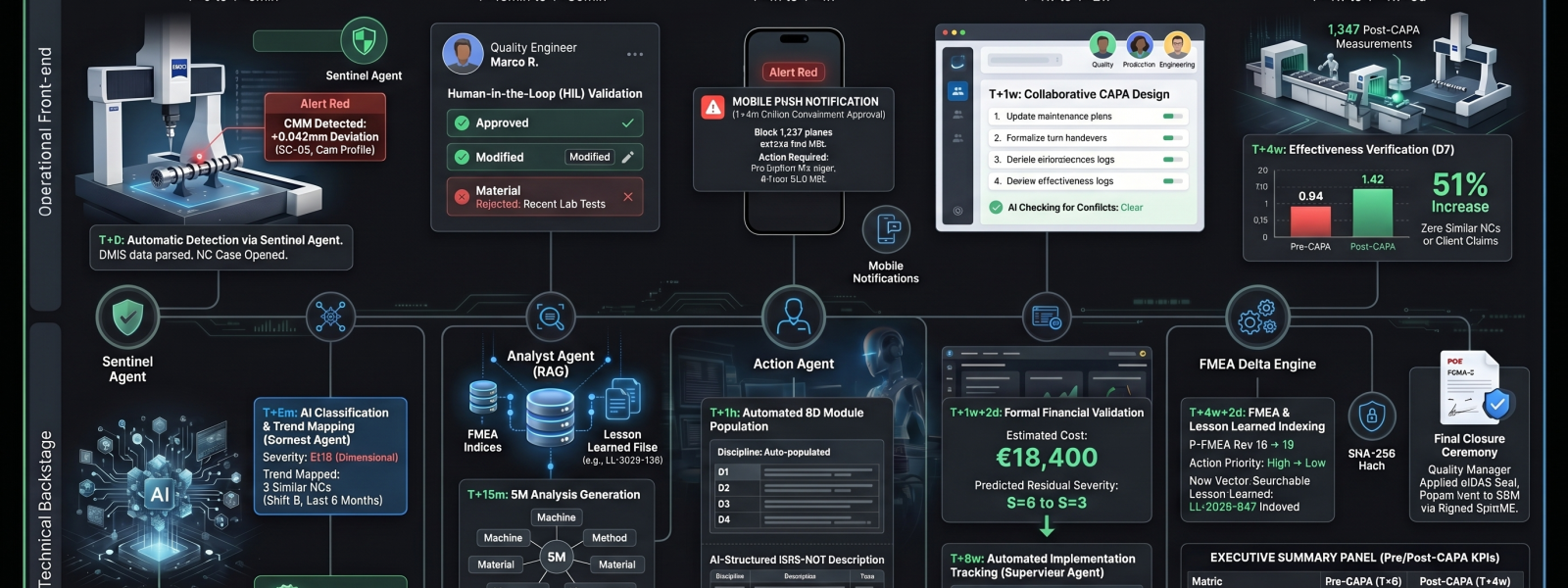
What happens when a quality alert triggers itself, before the operator even picks up the phone
This scenario is based on a simulated environment built by Corvalys using real IATF 16949 data structures and an ICE 1.6 TDI camshaft production context. It illustrates how a multi-agent AI system would handle a real non-conformity event in an automotive powertrain plant. No client data has been used.
It is 6:14 AM on the production floor of an automotive powertrain plant. A coordinate measuring machine finishes its routine check on a 1.6 TDI camshaft. One number is wrong, 28.542 mm where the tolerance allows 28.520 at most.
In a traditional plant, what follows is familiar: a manual alert, a phone call, a quality engineer pulling up a spreadsheet, a shift handover with incomplete notes, and a non-conformity report that takes hours to open properly.
In this scenario, the workflow had already started before the operator confirmed the alert on the screen.
The problem this scenario addresses
Quality teams in manufacturing spend a significant part of their week on documentation, alert routing, and historical lookups before they even begin analysing the actual problem. Non-conformity reports get opened late, root cause investigations start from scratch rather than from institutional memory, and corrective actions often lose momentum once the diagnosis is made.
The result: the same failures reappear, the same manual checks repeat, and knowledge that exists inside the plant stays locked in archives nobody searches when it matters most.
How the system worked, step by step
Detection happened in seconds, not minutes
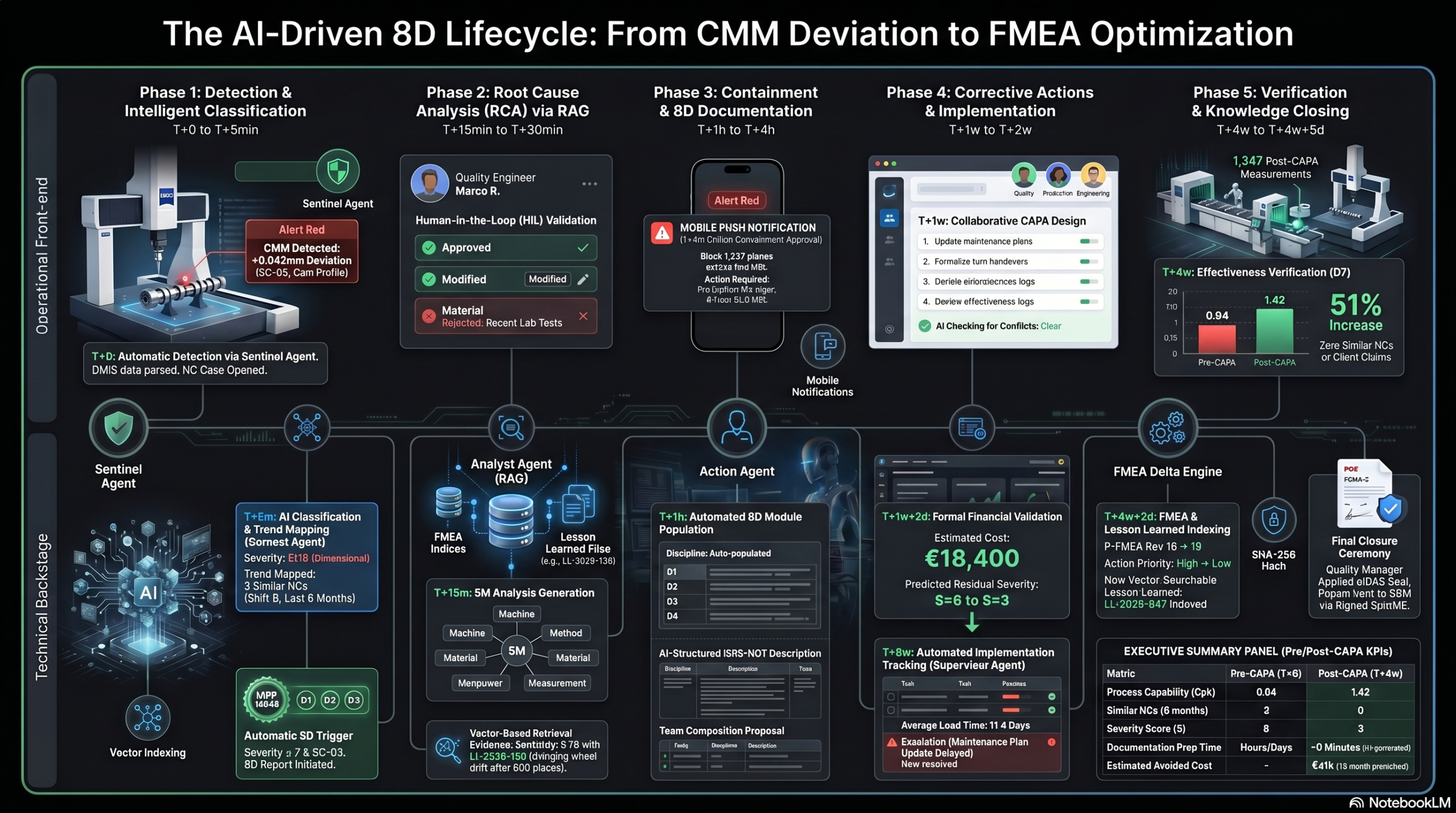
The Sentinel Agent read the measurement data directly from the CMM software and opened non-conformity case NC-2026-0489 automatically. No manual entry. No delay. The operator confirmed the alert on the HMI screen, but the process was already running. Every action was secured with a digital hash to satisfy IATF 7.5 document integrity requirements from the very first second.
The system recognised a pattern, not just a number
Within five minutes, a second agent had scanned six months of historical records and found that three similar issues had occurred on the same machine during the same shift window. This was not a random spike. The risk score was calculated automatically, and the system triggered an 8D investigation based on a clear, objective rule: any Severity 7 or above on a Special Characteristic requires immediate escalation. No subjective hesitation. No shift-handover delay.
Root cause analysis used the plant's own memory
Instead of starting with a blank Ishikawa diagram, the Analyst Agent searched historical lesson-learned files and identified a directly relevant case: a CNC program update had extended the wheel dressing interval from 1,000 to 1,200 pieces, causing gradual CBN tool drift. The connection was flagged with a similarity score and the source file was linked directly, so the quality engineer could verify the finding, not simply accept it.
A separate Critic Agent reviewed the analysis for accuracy before it was presented to the engineer. The human reviewed, approved, and modified one point. The system updated accordingly.
Containment was approved on a mobile phone, not in a meeting
The production and quality managers received a mobile notification with the full business case already calculated: 842 pieces to sort, 3,840 euros in immediate containment cost, against 18,400 euros in projected CAPA cost. They had four hours to decide. Once approved, the warehouse management and ERP systems were updated automatically via API.
The fix closed a loop the plant did not know was open
After corrective actions were implemented, the process capability index for the affected camshaft characteristic rose from 0.94 to 1.42, a 51 percent improvement. The system generated a new lesson-learned entry and proposed an update to the Process FMEA, adding a previously undocumented failure mode for accelerated CBN wheel wear. The quality engineer reviewed the proposal and applied a digital signature. The knowledge was indexed and made searchable for the next occurrence.
What this means for a quality team
| Before | After |
|---|---|
| Non-conformity report opened manually, often hours later | Case opened automatically in seconds |
| Root cause investigation starts from a blank page | System surfaces relevant historical cases immediately |
| Containment decision made in the next shift meeting | Mobile approval with full business case within four hours |
| FMEA reviewed annually, if at all | Update proposed automatically after each verified corrective action |
| Documentation: several hours per case | Documentation: minutes, AI-assisted with human sign-off |
Estimated avoided non-conformity cost over 12 months in this scenario: 41,000 euros.
A note on human control
Every approval, every validation, and every FMEA update in this system required a human signature. The AI did not act autonomously on any decision carrying business or compliance consequence.
What changed is what the engineer spent time on, not on finding information and completing forms, but on reviewing evidence and making decisions.
If your quality team is spending more time documenting problems than preventing them, the bottleneck is probably not the people. It is the process that surrounds them.
Does this scenario sound familiar?
Talk to us about how this approach could work in your production environment. We start with a short conversation about your current quality process. No commitment required.